


Welcome back to Thinking Like a Mountain!
Quick housekeeping: I’d appreciate your patience as I navigate a busier-than-normal few weeks ahead. My wife and I are closing on a house this week (finally, yay!) and will be juggling more responsibilities than usual. It needs some work…
Anyway, you'll notice these issues are temporarily shorter, but no less thoughtful! I'm committed to keeping our exploration of ecological consciousness alive, and once I’m settled in and with internet, I’ll be back full throttle!
For now, a mini newsletter 💚
The Languages We've Forgotten 🔊
If you’ve been following along issue by issue, you know that a significant focus of my writing aims to highlight the fact that we've (humans) mastered the phonetic alphabet (good for us), but as a result, have grown deaf to the sensory languages that sustained our ancestors for who knows how long. The living earth speaks constantly; in bird calls, wind patterns, wave rhythms, and a thousand other dialects we've forgotten how to hear.
Let’s briefly delve into what it might mean to reconnect with these ancient conversations.
Intelligence Networks 🌐
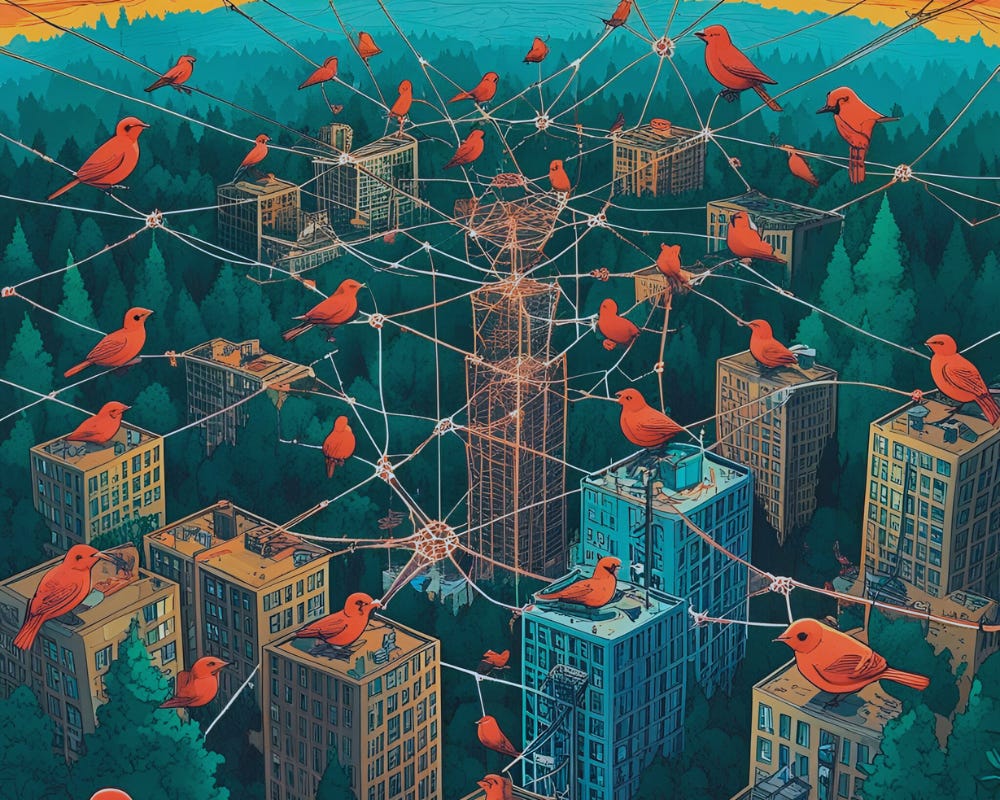
Birds are not as dumb as we think (seagulls might be an exception). They see everything from far above, a god’s-eye view. Their calls are an intelligence network spanning entire landscapes. The sharp alarm call of a jay announces a hawk's presence miles before we'd notice. The territorial song of a robin at dawn maps invisible boundaries. Crows gathering and cawing urgently? Something's wrong; a predator, an injury, a disturbance in their world is afoot, or awing.
Indigenous trackers know that following bird language is like reading the forest's newspaper. The birds tell you who passed through, when, and where they're headed. Modern humans walk through this constant chatter as if it were background noise. Imagine the dimensions of life that would open up to your awareness if you could understand this language.
Earth’s Body Language 🌍
Before weather apps, humans read the sky like a book. Not just "red sky at night, sailor's delight!" — but discerned the subtle language of cloud formation, air pressure, wind direction, and temperature fluctuation. The way cirrus clouds stretch and thicken. How morning mist behaves differently in the presence of rain versus clear weather. The feeling in your joints when pressure drops.
Sailors still count wave sets, knowing that every seventh or ninth wave in a series carries more power. Surfers feel this rhythm in their bodies, timing their entry into the ocean's pulse — Chasing Mavericks? Anyone?
Plants speak through their posture. Think about a tree leaning consistently away from prevailing winds and moss growing thicker on the north side of the rocks. The way flowers track the sun's arc, or how leaves curl before storms. Gardeners who truly listen can read soil health in the color of their plants' leaves and sense water stress before it begins to wilt.
Even the forest floor tells stories of deer trails worn into distinct patterns, scattered pinecone fragments that reveal where squirrels feed, and concentric rings where fairy ring mushrooms mark their underground networks.
The Forgotten Senses 🙉🙈🙊
Our ancestors navigated by star patterns, felt magnetic north in their bones, and detected rain hours before it appeared as clouds. They could distinguish dozens of wind directions, each carrying different information about weather, season, and distant lands.
Some cultures still read the tremors in spider webs to predict earthquakes. Others feel the electrical charge that builds before lightning, or sense the subsonic vibrations that elephants use to communicate across vast distances.
Our human phonetic alphabet trained us to think in linear sequences; one letter, one word, one sentence at a time. But natural languages happen simultaneously: the wind carries scent, while birds alarm, while pressure drops, while leaves rustle. It's symphonic, not sequential.
We traded this rich sensory conversation for abstract symbols on pages and screens. We gained tremendous power over the material world but lost our intimacy with life.
Relearning these old languages isn't about becoming an expert in all things wilderness! Our task is only to remember that we live inside a constant conversation. Even in cities, pigeons tell stories about urban rhythms. Street trees respond to pollution levels. Storm drains sing different songs depending on the season. Wherever you live, you can practice learning these languages.
The invitation is simple: What if we listened as if our lives depended on it?
Because, ultimately, they do.
Integration Practice 👂
This week, choose one natural phenomenon near you and become a student of its language. Maybe it's the quality of light at different times of day. The sound patterns of rain on various surfaces. How shadows move across your wall. The rhythm of insects in the evening. Life’s the limit.
Don't try to understand it intellectually.
Instead, listen.
Let your body remember what it means to be in conversation with the living world.
Thanks for reading! 🙏
Quick reminder: notes, posts, and newsletters will be slowing down for the next few weeks while I manage some significant life changes! This is temporary.
With love,
—The Green Philosopher
You are right, of course, but the challenge is actually learning HOW to listen. Right now, living in the city, my main listening is of the plants in my garden.
Very interesting read 🙏👍