

The Umbra of Understanding
How Shadow Perception Reveals Our Ecological Blindness

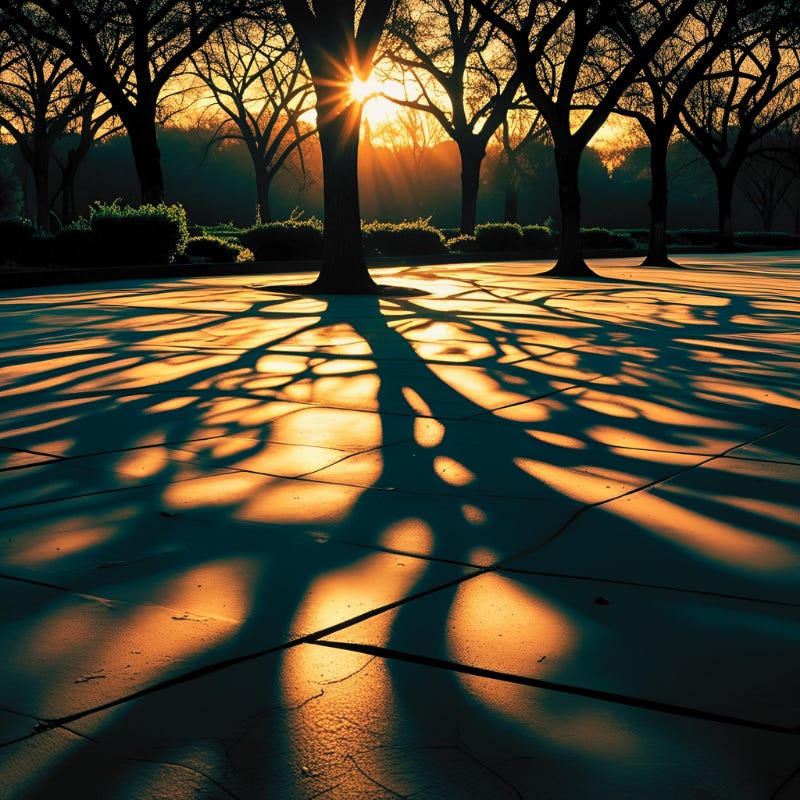
Are shadows flat?
Believe it or not, how we answer this question reveals a lot about the way we view the world.
Standing in the sun, we see dark silhouettes of ourselves cast on the ground and think of them as two-dimensional shapes, an absence of light painted on a surface like a cookie cutter stamping forms into the days gorgeous rays.
But if something steps into that shadow, you soon discover that nothing could never stand on the darkness, we can only become wrapped within it.
It enshrouds us, because a shadow is 3-dimensional.
Perceptual Errors
A shadow is no longer a flat projection from this perspective; it turns into a 3D volume of space, or an umbra, that extends from the object casting it all the way to where it appears to end. You can move through its depths while feeling the coolness of its air. What seemed like a simple outline from outside looking in, becomes a rich, inhabitable realm of shade.
Interpreting shadows as 2-dimensional is a perceptual error and has consequences. This view can mistake volume for surface area, and in my opinion, mirrors how we've trained ourselves to see the natural world. When we look at a forest and just see timber, or view mountains as hills of ore, we are seeing these 3-dimensional living systems as stable, 2D objects. Metaphorically, of course.
A prime example is how oceans have become a cutthroat economy of seafood by this logic. We judge it by what we can pull to the surface, rather than by its unfathomable depth and mystery.
As observers viewing shadows from a single vantage point, we've flattened the 3-dimensional reality of these living, breathing ecological systems into 2-dimensional resources ready for harvest. The depths and interconnected relationships that make these systems alive all collapse into a simple pancaked map of utility.
Imagine a single tree, for an example.
From our extractive perspective (outside the shadow), it appears as a column of harvestable wood, a flat economic unit measured in board feet; it’s the essence of a house. But step into the umbra of its ecological reality, and the tree becomes infinitely complex. The trunk is a city of insects, the branches a floating highway for squirrels. The number of fungal networks lining the roots alone would warrant its own universe! If you’re reading my work, I doubt I have to tell you any of this. But here we are.
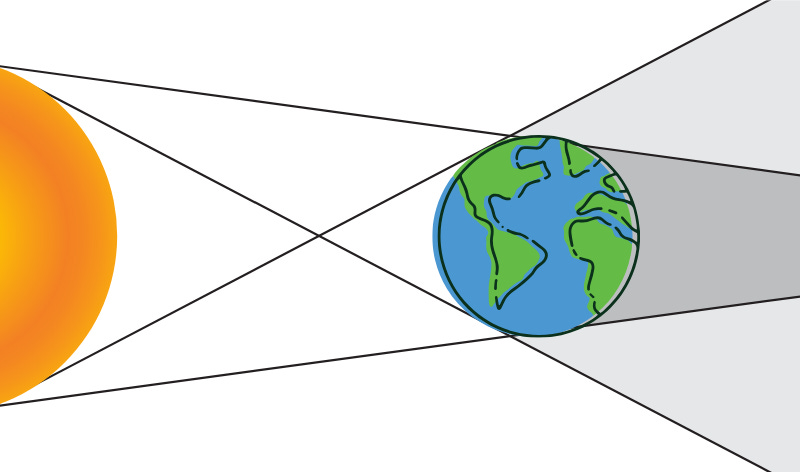
Depth & Volume
This perceptual flattening we see in industrialized societies is economically necessary, but also environmentally degrading, not to mention counterproductive to our survival in the long run. To extract efficiently and without remorse, we must first strip away complexity.
We have to dehumanize the earth before we can properly rape it. The problem is: by dehumanizing the Earth, we denaturalize ourselves. Hence our modern-day crises.
In this commodity view of nature, we reduce it to simple, measurable units. The thick umbra of ecological relations becomes inconvenient when you're trying to calculate quarterly profits from forest clear-cuts or justify mining operations in protected Indigenous lands.
Depth certainly complicates extraction, but volume (Length x Width x Height) makes it almost impossible.
While shadows reveal their true nature to those who are willing to step inside them, ecological systems reveal their dimensionality to those willing to inhabit their complexity. Indigenous knowledge systems, evolved over millennia of living within natural systems, rather than upon them, have always remained immersed in this voluminous shared space.
The forest is seen, from inside the umbra, as a living entity with its own intelligence and complexity. Recognition that every action ripples through these dimensions of connection comes naturally from within the eco-umbra’s shaded space.
Stepping into the Shadow
The shift from seeing nature as flat, to experiencing it as an organic dimensional system requires the same perceptual courage needed to step into a shadow. Challenge yourself to abandon the comfortable distance of the observer and become participants in the darkness beneath the canopy.
The umbra of eco-understanding proves that nothing exists in isolation. Every element participates in a 3-dimensional web of life that extends far beyond what appears on the surface.
To heal our relationship with the natural world, we have to heal our perception of it. To do that, we have to immerse ourselves in its ways.
There is no alternative approach.
Learning to see shadows as voluminous is a good start and will help the brain at the very least notice more depth within forms that may appear flat at first glance; but to truly digest this lesson, we have to step into the sometimes-unfamiliar, sometimes-scary, realm of the umbral shadow and fully participate within the ecological systems that hold our planet together.
—The Green Philosopher
I remember the first time I saw my shadow in 3D.
As a child, I wandered through the forest, searching for mushrooms.
It was a foggy morning.
As I stepped onto the ridge of a slope, the sun broke through, shining on my back.
Bathed in golden mist, I stood still, awestruck—watching the shadows of my body and the trees dance before me.
Pure catharsis!